The whole tender pack,
taken apart by tomorrow morning.
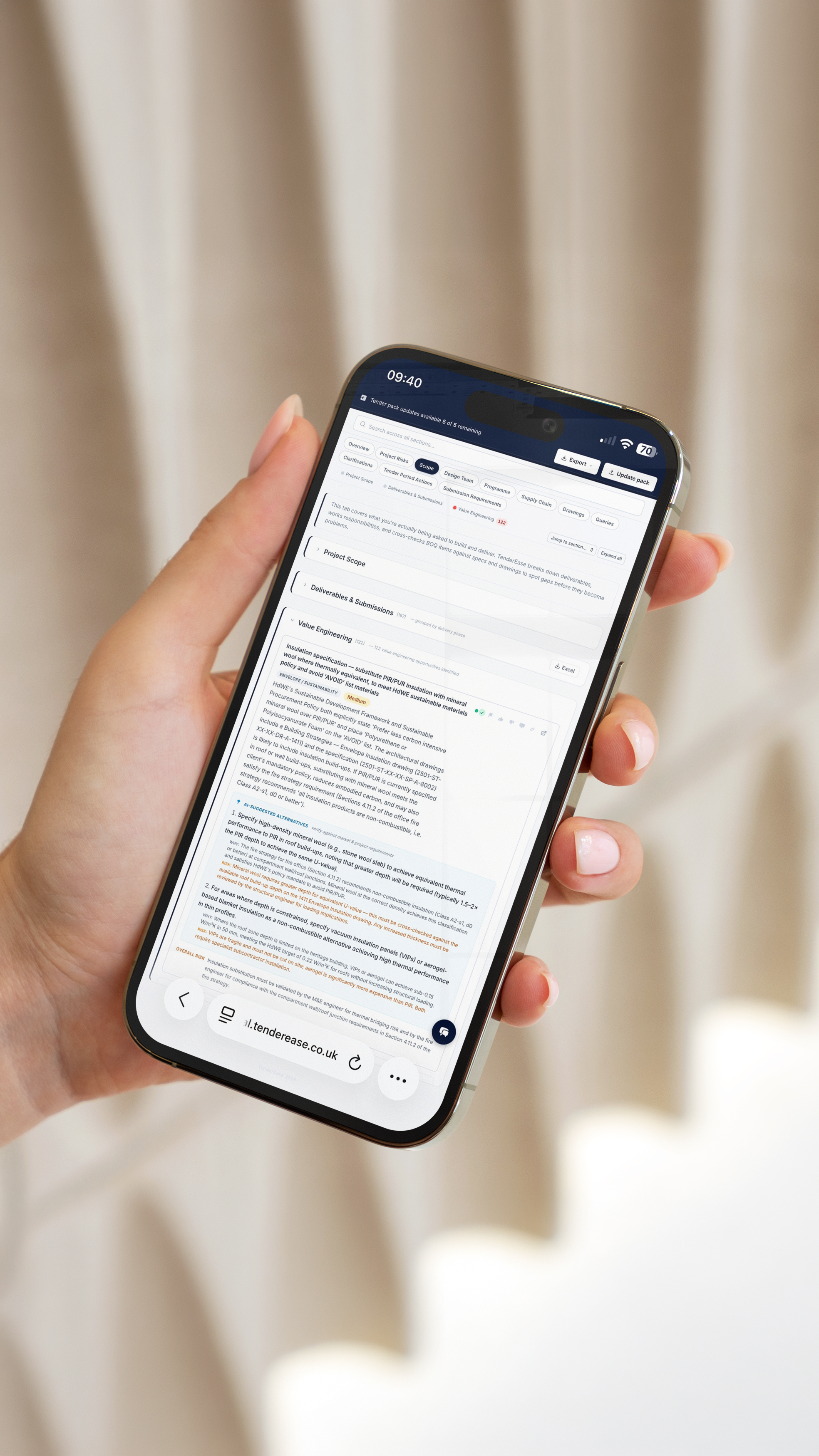
Everything in the pack that changes your price, your programme or your decision to bid, found, evaluated and cited to the page, in one dashboard your whole bid team works in.
Priced per tender pack, based on the number of pages and analysable content.
Most land between £900 and £1,400, everything included.

Ask a general AI tool to read a tender pack and it tells you what’s in it.
TenderEase tells you what it does to your price.
The clauses that move risk onto you.
The buildability problems in the survey information
What the client's accounts say about whether you get paid.
Every requirement you have to answer, with the answers drafted from the findings.
What TenderEase does for your business

Launch the tender sooner
Get the bid moving on day one. Instead of waiting for someone to work through the pack before the team can start, you get a structured read straight away, so the tender launches sooner and you win back time at the front end where it counts.

The main points, summarised
Know the shape of the job in minutes: what the tender is, what's onerous, what's missing and what needs chasing, before you commit serious hours to pricing it.

Get the whole team across it, fast
The key information found, summarised and cited, so your estimators, commercial team and PM aren't each hunting through hundreds of documents for the clause, the date or the drawing that matters.

It frees your team, it doesn't replace them
TenderEase doesn't do the pre-construction teams job. It clears the groundwork so your people spend their expertise on the real risks and the commercial calls, instead of churning through hundreds of pages just to work out what they're dealing with.

Three steps.
No call required.
1
You upload the tender docs
Any size, any format. Drag the whole lot into the secure uploader and pay by card. No account to set up.
2
We take the pack apart
Every page read. The contract and its amendments, the employer's requirements, the specification against the drawings, the ground investigation, the planning conditions and the quality questionnaire. Every finding cited to the document and page it came from.
3
Your team prices it
The analysis arrives within 24 hours as a password-gated link. Everyone on the bid works from the same version, from the estimator pricing it to the director signing it off.

The real dashboard. Cited, in full, in 24 hours.
What you receive.
-
![Outline of a padlock with a shield and checkmark symbol, representing security and protection.]()
Secure access
A branded, shareable web portal with every finding cited back to its source. Send the link to your team, your bid review team, or a subcontractor, access controlled by password and expiry date.
-
![Line graph and charts on a computer analytics dashboard.]()
Full-length dashboard
Every section of analysis: commercial, programme, CDM, buildability, VE, RFIs, inconsistencies, in one structured dashboard, organised the way a pre-construction team actually works.
-
![Outline of a voice recording, profile icon, and microphone, representing audio recording or voice data.]()
Audio briefing
A podcast-style summary of the pack, in plain English.
For the commute, the site visit, or the twenty minutes before a bid review meeting. -
![Line drawing of a medical report, a prescription pad with a plus sign, and a clock indicating time or schedule.]()
Addendums added anytime
Tender pack revisions happen. Drawings reissued, prelims amended, clarifications circulated.
Upload the addendum at any point and TenderEase re-runs against the new content, surfacing what's changed. -
![Outline of a document with quotation marks and lines of text, accompanied by a magnifying glass focusing on a smaller document or note marked with the number 1.]()
Full citations to source
Every insight links to the exact PDF and page it was drawn from.
No hallucinations, no "the system says so". Your team can verify every finding in one click.
-
![Outline of a report with charts and a share icon.]()
Exportable reports
Download the analysis as a PDF for internal record-keeping, bid files, or to attach to risk registers. Branded with your company's colours and logo if you choose.
-
![Blueprint or architectural plan with measurements and a magnifying glass.]()
Drawing analysis
Every drawing in the pack surfaced in a searchable grid, with title-block information extracted and an AI-generated insight for each sheet.
See at a glance what drawings exist, what they cover, where they cross-reference the specification, and where they contradict it.
-
![Orange outline drawing of a robot face inside a chat bubble, with two smaller chat bubbles containing three dots and lines representing conversation.]()
Built-in chat
Ask any question of the tender pack and get a sourced answer.
-
![Illustration of financial management and security, including a hard hat, a gear with a dollar sign, a bar chart, and a shield with a checkmark.]()
Value engineering
Opportunities surfaced from the specification to give your bid the upper hand.
-
![Outline of two speech bubbles with a question mark inside one and lines inside the other, surrounded by a check mark and curved line.]()
RFI's and clarifications
A list of important questions to raise with the client before pricing.
-
![Enquiry Packs]()
Enquiry Packs
The drawings split by trade package automatically, with the drawings and specification sections each subcontractor needs.
-
![]()
Submission Writer
Every quality question listed, with a first draft written from the findings. Your bid team edits rather than starts from nothing.
-
![]()
Planning Portal Documents
We find the application on the local authority portal and pull the conditions, the section 106 and the approved drawings. Obligations that never made it into the tender pack get flagged.
-
![]()
Client Covenant
The employer's filed accounts read alongside the tender. What their balance sheet says about whether the job gets funded and whether you get paid.













AUDIO BRIEFING
The whole tender, talked through.
Every analysis comes with a spoken briefing: a clear walkthrough of the pack's key risks, programme, scope and actions. Put it on in the car on the way to site, or share it with the bid team so everyone arrives at the kick-off already across the detail, without anyone having to read 2,000 pages first. Not everyone has the time to sit and read a dashboard.
The audio briefing lets the wider team take in the tender hands-free, on the move or in the background, so the people who need the headlines get them without ploughing through the detail themselves.
Harmony Works, Sheffield - Tender Briefing
In this briefing
PROJECT LAUNCH DECK
The launch deck, ready before the kick-off.
Every analysis produces a ready-to-present Project Launch deck, so the kick-off can happen on day one instead of day five.
Normally a bid manager spends the first days of a tender reading through the pack, pulling out the key facts, the risks and the angles, then building a launch deck to take the rest of the pre-construction team through it. TenderEase does that part for you.
It's a starting point. Your bid manager edits and makes their own adjustments. The groundwork is simply already done.
SUBMISSION WRITER
Your answers, already started.
The analysis does not stop at telling you what is in the pack.
Every quality question the client has asked is listed out, with a first draft written from the findings, the drawings and the specification your team has just uploaded.
The facts come from the tender, cited to the page. The judgement calls come from you, through three short questions per section. What comes out is a Word document in your house style, ready for the bid team to work on.
From the pack
- Basement to both properties Dwg 402
- Design responsibility novated ITT p.14
- Party Wall Act awards required ER p.61
- No rear crane access Site plan p.3
Example draft: 40-42 St Peter's Street comprises two Victorian mid-terrace townhouses, refurbished and converted with basement extensions to both. We hold full design responsibility from the point of novation of the existing consultant team. Before any excavation we will commission a pre-construction structural survey of the party walls and the shared flank walls to both neighbours, served under the Party Wall etc. Act 1996. Awards will be agreed with the adjoining owners' surveyors before breaking ground. The narrow frontage and mid-terrace position mean there is no rear crane access, so all plant and material movements are planned around a single controlled point at the front elevation.
TRUST & DATA SECURITY
Your tender. Your data. Handled properly
Handing over a live tender is a big ask. Here is exactly how TenderEase keeps it secure, and what happens to it afterwards.

Your pack is uploaded over a secure connection and stored encrypted, in transit and at rest.
Encrypted end to end


Every dashboard is password-gated. Only the people you share the link and password with can open it.
Access you control

Never used to train shared models
Your documents are analysed for your review only, never used to train anything other clients can access.

Yours to delete
Ask us to remove a pack and it is gone. Packs are deleted on request, with a clear retention period by default.

A published Privacy Policy, Terms of Service and Data Processing Agreement sit behind the product. No offshore black box.
A registered UK company

If the analysis is not useful, tell us and we will put it right or refund you.
Backed by a guarantee

Need an NDA? We’ll sign yours.
Won't share a live tender without one in place? Send us your NDA, or use ours, and we'll have it signed before anything is uploaded.
Questions before you order? Email sales@tenderease.co.uk or book a short call. You will never be pushed onto one. Read our Privacy Policy, Terms of Service and Data Processing Agreement.
Get an instant quote for your analysis
No need to call or email for a bespoke price for your project, just follow the steps below:
What we look for.
Every tender pack is different, but the risks hide in similar places. Here's a sample of what TenderEase surfaces on a typical tender pack. Included but not limited to the below.
-
The contractual traps that cost money when they're missed - uncapped liabilities, aggressive liquidated damages, unusual parent company guarantee requirements, onerous collateral warranty obligations, and payment terms that sit outside the Construction Act. We surface non-standard JCT and NEC amendments clause by clause, flagging anything materially different from the unamended form, and highlighting deletions as well as insertions.
For each risk, TenderEase goes further than flagging it. You get suggested control measures, practical ways to mitigate or push back during negotiation, the commercial opportunities a clause may create alongside its exposure, and the specific language your team could propose as an alternative. Every finding cites the exact clause number and page it came from. The analysis is a starting point for your commercial director, not a replacement for their judgement.
-
Every date that matters for pricing and delivery. Tender return deadline, clarification cut-off, interview dates, proposed start on site, sectional completion dates, practical completion, and any phasing requirements buried in the preliminaries. We pull long-lead items requiring early procurement decisions, liquidated damages rates per week of delay, and any milestones with specific performance obligations attached.
-
Every deliverable required at tender stage: method statements, programmes, CVs, case studies, insurance certificates, financial statements, quality plans, environmental policies, Modern Slavery declarations, and any project-specific questionnaires.
We flag the format required (signed PDF, Word, specific template), the person responsible for signing each, and any document that requires a sub-consultant or specialist supplier input.
-
Pre-construction information, principal designer arrangements, principal contractor duties under CDM 2015, and any Higher-Risk Building implications under the Building Safety Act 2022. We surface the client's residual designer duties, any existing F10 notifications, HSE correspondence referenced in the pack, and the Gateway stages that apply if the scheme falls within HRB scope.
-
The things that should match but don't, drawings that contradict the specification, schedules that contradict the prelims, room data sheets that contradict the finishes schedule, and employer's requirements that contradict the contract amendments.
Every inconsistency is surfaced with both sources cited, so your team can raise the right RFI before submission rather than carry the risk into the bid.
-
Areas where specification tightening, alternative products, or design simplification could meaningfully reduce cost.
We flag over-specified finishes, unusually prescriptive product references where equal-and-approved clauses would permit alternatives, repeated over-design in structural elements, and MEP specifications that exceed current regulatory minimums.
These are surfaced as opportunities, not recommendations, your team makes the call.
-
The ambiguities, contradictions, and missing information that should go back to the design team before the bid is submitted rather than after.
We draft the RFI in plain English, cite the page and document it relates to, and categorise it by urgency, clarifications needed to price, clarifications needed to programme, and clarifications that can be left to contract stage.
-
Full planning permission conditions, any S106 obligations, BNG (Biodiversity Net Gain) requirements, S278 highways agreements, S38 adoption requirements, S104 drainage agreements, party wall implications, and any listed building or conservation area constraints.
Each condition is surfaced with the trigger point (pre-commencement, pre-occupation, etc.), the discharging authority, and the document it sits in.
-
The logistics and sequencing factors a site team will need to think about, pulled together from what the pack surfaces. Access and site constraints mentioned across planning conditions, method statements, and employer's requirements; working-hour or environmental restrictions; neighbour and stakeholder sensitivities flagged in the documents; and programme phasing or handover requirements that will shape the build sequence.
-
Who is on the design team, who has been novated, and who is yours to appoint, all confirmed against the source. TenderEase checks the statutory position on planning, party wall and building control, and flags the specialist reports and strategies the project should have but the pack is missing, with an RFI ready to send.

Case study
A design obligation that needed qualifying, found on day one.
What it found
Click each finding to expand the detail.
01 A fitness for purpose obligation beyond the usual design standard
Clause 2.17.1 of the amended JCT Design and Build replaced the reasonable skill and care wording with a fitness for purpose obligation. The commercial review flagged that this could extend the contractor’s design liability beyond the usual professional indemnity-backed standard. It was raised on day one so the team could qualify the obligation and confirm the insurance position before tender return.
02 Liquidated damages rate not stated
The Contract Particulars left the liquidated damages rate blank, while the preliminaries referred to damages at the rate stated in the contract. The inconsistency was raised as an RFI on day one so the team could confirm whether liquidated damages applied and, if so, at what rate. The rate was subsequently confirmed by addendum.
03 Riser penetrations through a post-tensioned slab
The services drawings showed 14 new riser openings through the existing slab. The building is 1980s post-tensioned, but no tendon survey was included in the tender information. Before the openings could be formed, the tendon locations would need to be established and the proposed penetrations reviewed. The team therefore allowed for the survey and design review, with the final opening locations, sequencing and any local strengthening dependent on those findings.
04 AHU delivery route did not match the plant dimensions
The plant schedule showed roof-level AHUs with modules up to 2.4m high, while the goods-lift door opening was 1.8m. The tender information did not set out how the plant was intended to reach roof level. The team raised whether the units would be supplied in sections or whether an external lift and temporary access arrangements would be required, so the logistics, programme and preliminaries could be allowed for properly.
05 Employer covenant required further review
The covenant check showed the contracting entity was a special purpose vehicle incorporated in 2023, with net assets of £180,000 in its latest filed accounts. No parent company guarantee was included in the tender pack. The commercial team flagged the employer covenant for further review and sought clarification on project funding and whether any parent company support would be available before contract.
06 Planning conditions affected the logistics assumptions
The borough’s planning portal included a condition requiring an approved construction logistics plan before works started and restricting deliveries before 09:30. Those conditions were not included in the tender pack. The team flagged them so the logistics plan, delivery strategy, programme and preliminaries reflected the actual site restrictions.
How the team used it
Tender launched on day one
The launch deck was generated with the analysis, allowing estimating, planning and commercial to begin from the same picture the next morning.
Senior staff arrived informed
The MD and commercial director used the audio briefing before the mid-tender interview and could discuss the major project risks without a separate estimator briefing.
Enquiries chased on evidence
The estimator could see which subcontractors had opened their trade packages, focus the chasing, and secure two additional mechanical prices before settlement.
Submission drafts started with facts
Logistics, methodology and social value drafts already carried the relevant project information, giving the bid manager a grounded first draft rather than a blank page.
Questions answered in the room
During settlement, the team could retrieve answers from the tender pack immediately instead of sending people away to search for them.
The outcome
The bid still went in on the deadline. What changed was where the six weeks went: the first week was spent pricing rather than reading, key contractual issues were on the client's desk in the first 24 hours, and the qualifications schedule was built from what was actually in the pack.
“The value was having the issues in front of us early enough to do something about them. It meant the team could price, qualify and ask the right questions while there was still time to get proper answers.”
Pre-construction manager, London main contractor
Construction is an unforgiving industry. Margins are thin, contracts run for years, and a single tender misjudged at the outset can follow a company long after the job is won. The onerous clause nobody flagged, the scope that went unpriced, the risk that only surfaced in month three when it was already too late to price it. One bad job is sometimes all it takes to put real strain on an otherwise strong business.
We built TenderEase to combat exactly that. So a contractor can enter a contract and a project knowing precisely what they've taken on, with every page read and every risk on the table before the price goes in, not after.
Our team have spent years in UK pre-construction, on the receiving end of these packs, and TenderEase is the tool we always wanted on those jobs. It reads every page so nobody has to do it at midnight, and it shows its working, with every finding cited to the source, so you can check it rather than take it on faith.
We built it to make good teams faster and better protected, never to replace their judgement.